
In our previous updates, we detailed how the structural chassis of our first platform transitioned from a digital 3D blueprint to a physical, laser-cut frame. However, an educational robot is more than just a sturdy skeleton; it requires a nervous system that is both robust enough for a classroom and precise enough for high-level engineering.
Currently, our engineering team in East Delhi is immersed in the most critical phase of the journey: the integration of electronics, the fabrication of custom circuit boards, and the development of the underlying logic that transforms the YUVABOT v1.0 from a static model into an intelligent machine.
The Workbench: Where Engineering Meets Education
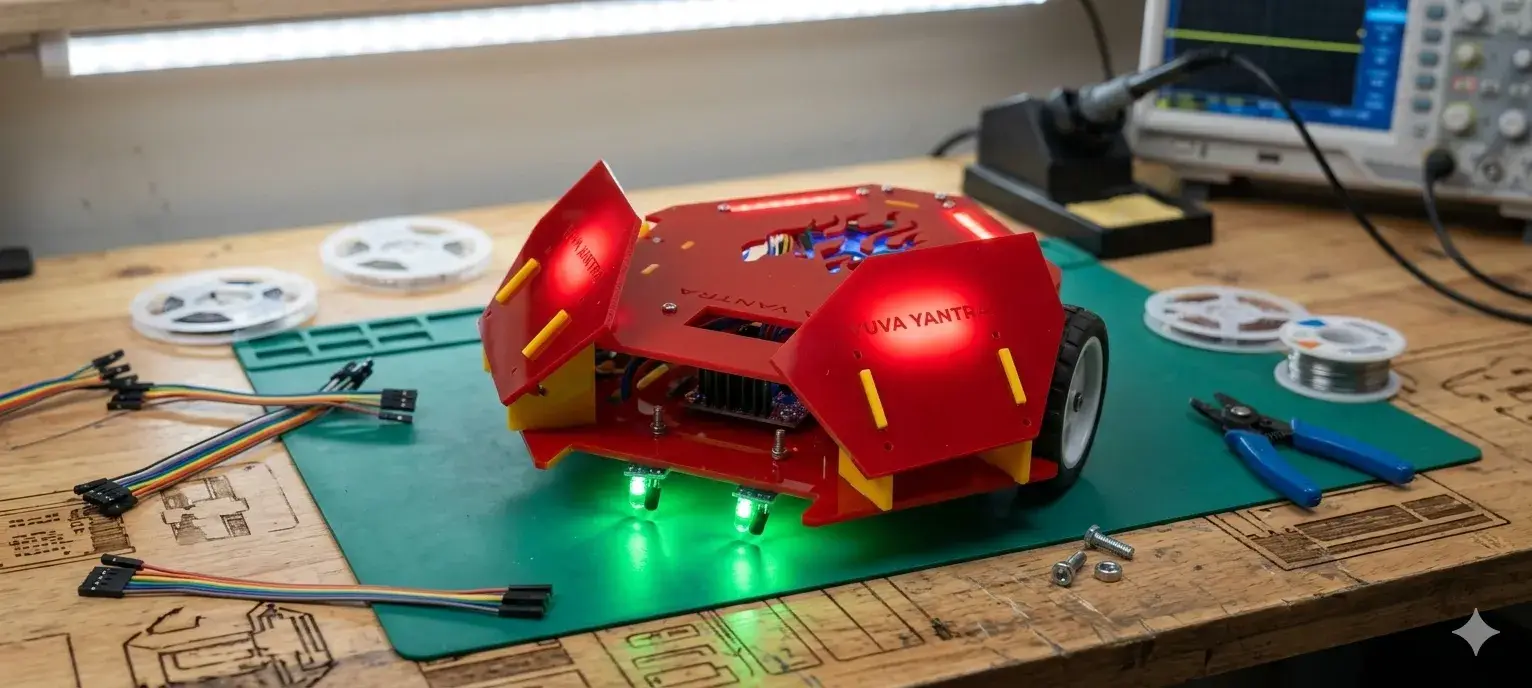
As captured on our current testing bench, the development environment for the YUVABOT v1.0 reflects a commitment to professional-grade standards. The background of our lab is defined not just by the striking red double-decker chassis, but by the tools of the trade: high-precision oscilloscopes for signal validation and industrial soldering stations for component integration.
This setup is vital for demonstrating Experience—the cornerstone of the 2026 E-E-A-T framework. We aren’t simply assembling pre-made parts; we are validating the electrical integrity of every pulse that moves a motor or triggers a sensor. By showing the “messy parts” of engineering—the jumper wire prototypes, the signal waves on a screen, and the raw screws on a green cutting mat—we provide students with a transparent look at how real-world technology is born.
1. Beyond Jumper Wires: The Custom PCB Revolution
A primary pain point in educational robotics is the “connection failure.” Traditional beginner kits often rely on a web of loose wires that can easily disconnect during a lesson, leading to student frustration and a loss of teaching time . To solve this, our current focus is the development of a custom-integrated circuit board (PCB).
By transitioning from standard breadboards to a proprietary PCB, we achieve several technical advantages:
Signal Integrity: We use our testing equipment to monitor the pulse-width modulation (PWM) signals that control motor speed. A custom board reduces electrical noise, ensuring that the robot’s movements are smooth and predictable—even when navigating uneven classroom floors.
Durability and Safety: A dedicated board protects sensitive components from accidental short-circuits. This is especially critical in 2026, where digital safety and hardware longevity are top priorities for parents and school administrators .
Precision Tolerances: Just as our chassis was designed with 0.1mm tolerances, our electronic layouts are optimized for heat dissipation and signal efficiency, ensuring the hardware remains cool during extended workshop sessions.
2. Calibrating the Senses: The Infrastructure of Perception
The YUVABOT v1.0 is designed to “feel” its environment. As seen in our latest prototypes, the chassis features an array of sensory inputs, highlighted by green LED indicators at the base. These are not merely for aesthetics; they represent the successful calibration of our infrared (IR) sensor pack.
Infrared Navigation: These sensors allow the robot to perform complex “Line Following” tasks by detecting the contrast between different surfaces. Our calibration process involves testing these sensors under the diverse lighting conditions of Indian classrooms to ensure they remain accurate regardless of whether they are under bright LED lights or natural sunlight.
Obstacle Avoidance and Spatial Reasoning: We are currently integrating ultrasonic sensors that use sound waves to measure distance. This teaches students the fundamentals of “perception-action” loops—the basis of all modern automation and self-driving technology .
Logical Interfacing: By connecting these sensors to an industry-standard programmable controller, we enable students to move beyond basic movement and into the world of reactive intelligence .
3. The Logic: A Tiered Approach to Programming
Hardware is only as smart as the code that drives it. To align with the 2026-27 national literacy standards, we are developing a dual-language software ecosystem that scales with the student’s ability.
For the Young Innovator (Classes 3-5): We provide a library of visual logic blocks. This allows students to master the “if-this-then-that” logic required by the new curriculum without the barrier of complex syntax .
For the Aspiring Engineer (Classes 6-8): The YUVABOT v1.0 is fully optimized for high-level, industry-standard scripting languages. This ensures that the skills a student learns in school—such as data variables, conditional loops, and sensor interrupts—are the exact same skills used in professional engineering today .
The Yuvayantra Philosophy: Empowering Creators
The ultimate goal of our work in Shahdara, East Delhi, is to ensure that technology is not a “black box” for the next generation . When a student sees our red double-decker robot, we want them to understand what is happening under the hood.
In the 2026 search and education landscape, “Information Gain” is found in the details. By documenting our signal testing with oscilloscopes and our transition to custom circuitry, we aren’t just selling a product—we are sharing a roadmap for how to think like an engineer. We believe that by celebrating effort over the result and learning from “failed” prototypes on a workbench, we are building a generation of curious thinkers ready to create their own future .
As we move from the testing bench to the final production phase, we invite you to be part of the Yuvayantra journey. Let’s turn “lofty goals” into “practical clarity” together.
(https://yuvayantra.com) | [Join the Innovation Community]